
Metal Deburring with Flap Wheels & Deburring Discs
Deburring sharp edges: the #1 job for flap wheels in metal
Every laser-cut, punched, sheared or machined metal part comes off the machine with a burr, a razor-thin ridge of displaced metal along every cut edge. Burrs cut hands, tear gloves, stack up in assemblies so parts don't sit flat, and make paint and powder coat fail early, because coatings pull away from a sharp edge. Deburring means removing that ridge and leaving a small, consistent radius in its place. A flap wheel is the fastest hand-powered way to do it: the overlapping abrasive flaps wrap the edge as the wheel spins, breaking the burr and rounding the corner without gouging the flat faces on either side. For production volumes, stiff deburring discs do the same job in automatic machines, part after part.
Why metal shops use flap wheels: the random scratch pattern
Here is the part most abrasive suppliers never explain. A grinding disc, a belt sander or a wire wheel cuts in one direction, so it leaves linear scratches: parallel lines that catch the light and are instantly visible on metal, especially on stainless and aluminum. Your eye is built to spot straight lines. A flap wheel is different. Dozens of overlapping cloth flaps strike the surface at constantly changing angles as the wheel spins and you move it, so it leaves a random, non-directional scratch pattern. Random scratches scatter light instead of reflecting it in one direction, so tool marks seem to disappear. The deburred edge or blended weld melts into the surrounding surface instead of announcing itself with a stripe of parallel lines. That is why fabrication shops reach for a flap wheel for the final pass on visible metal work: not because it cuts faster than a grinder, but because it is the tool that hides its own tracks.
How to deburr metal edges with a flap wheel
- Clamp the part so the edge you are working is clear of the bench.
- Run the wheel along the edge at a 30 to 45 degree angle, moving steadily. Let the flaps wrap the corner. Do not press: pressure flattens the flaps and slows the cut.
- Make a pass on each side of the edge. Two light passes leave a cleaner radius than one heavy one.
- Check by touch (carefully): a deburred edge feels smooth and slightly rounded, with no ridge you can catch a fingernail on.
- For a visible surface, finish with a finer grit and keep the wheel moving in varied directions. That is what builds the random scratch pattern that hides the work.
Which grit for metal deburring
| Job | Grit | Note |
|---|---|---|
| Heavy burrs, weld cleanup | P60 to P80 | Fast cut; follow with a finer pass on visible work |
| Standard edge deburring | P100 to P120 | The workhorse range for sheet metal edges |
| Blending and final pass | P150 to P240 | Builds the fine random scratch pattern on stainless and aluminum |
Which tool for the job
Hand deburring and small parts: 2" drill-attached flap wheels reach inside cutouts and tight radii; 4" drill-attached wheels cover straight edges faster. Both chuck into any hand drill. All-day work: the pneumatic F3 (2") and F6 (4") run on shop air with no motor to overheat. Production volumes: stiff 12" and 14" deburring discs, sold by the box of 100, stack on machine arbors with 32mm and 50mm spacers to build exactly the working width an automatic deburring machine needs. Complete machines are at quickwood.com.
Deburring Discs and Flap Wheels
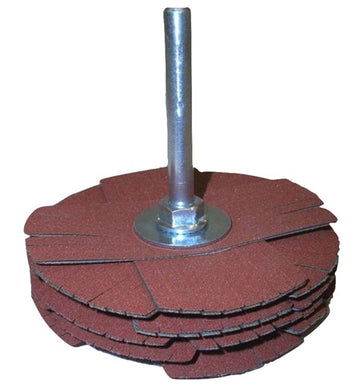 4" Star Wheel - Detail Sanding Head$16.00
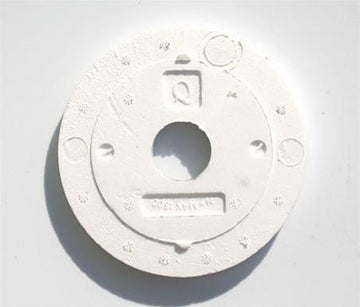 Deburring Disc Spacers - 32mm & 50mm$214.00
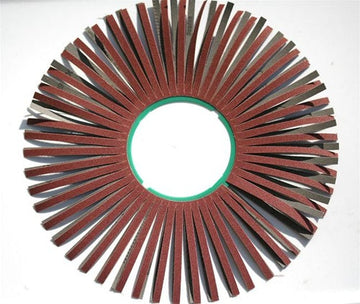 Deburring Discs 12" & 14" - Box of 100$856.00
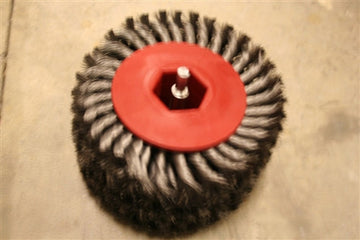 Twisted Steel Brush for Drill - 2" or 4" Wide$187.00+
Shop all: 12" discs · 14" discs · Spacers and end flanges · drill flap wheels · how to remove scratches from stainless · weld blending guide
Common Questions
Why do flap wheels hide scratches on metal?
Because the flaps strike the surface at constantly changing angles, they leave a random, non-directional scratch pattern. Linear scratches from a grinder or belt reflect light in one direction and stand out; random scratches scatter light, so the eye can't pick out the tool marks. The finished area blends into the surrounding metal.
Why round the edges of laser-cut parts?
Three reasons: safety (burrs cut hands), coating adhesion (paint and powder pull away from a sharp edge, so a small radius makes coatings last), and fit (burrs stack up in assemblies). A deburring pass leaves a consistent small radius on every edge of the part.
Deburring disc or flap wheel?
Hand work, shaped parts or small batches: flap wheel on a drill or air tool. Flat sheet metal parts at production volume: deburring discs in an automatic machine. The full comparison is in flap wheel vs flap disc.
Will a flap wheel work on stainless steel and aluminum?
Yes. Aluminum oxide flap wheels handle mild steel, stainless and aluminum. On stainless, keep a dedicated wheel that has never touched carbon steel to avoid embedding particles that later rust. On aluminum, use light pressure and let the flaps cut to keep the abrasive from loading. For finish repair on stainless, see how to remove scratches from stainless steel.